
Wellhead Valves and Their Role in Well Testing
Wellhead valves are fundamental to safe and efficient well testing, serving as the primary barriers for flow control and well isolation. They ensure hydrocarbons are directed, contained, or shut off as required, protecting personnel, equipment, and the environment. Each valve has distinct role, and together they form a layered safety system that underpins reliable reservoir evaluation. The lower master valve(LMV) is the primary shut-in valve at the base of the wellhead. It provides the first line of control when isolating the well during testing. Above it, the upper master valve(UMV) acts as a secondary barrier, ensuring redundancy in case the LMV fails. These two valves together guarantee secure well isolation.
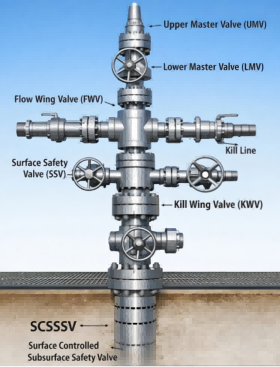
The flow wing valve(FWV) is the operational valve during testing, channeling hydrocarbons from the wellhead to the test line. Flow is then regulated through the choke manifold to achieve controlled rates for accurate reservoir evaluation. On the opposite side, the kill wing valve(KWV) provides access for pumping kill fluids or inhibitors into the well. The function is critical for well control interventions and chemical injection during testing operations. Safety is reinforced by the surface safety valve(SSV), which is integrated with the emergency shutdown system. It automatically closes the well in response to abnormal pressure or flow conditions, protecting against blowouts or equipment damage. For added security, especially in offshore or high-risk environments, the surface controlled subsurface safety valve(SCSSSV) is installed downhole. Controlled from the surface, it acts as a fail-safe barrier against uncontrolled reservoir flow.
Wellhead valves are indispensable in well testing. The LMV and UMV provide dual isolation, the FWV directs hydrocarbons to test equipment, the KWV enables controlled interventions, and the SSV and SCSSSV safeguard operations through automatic shutoff. Together, they form a comprehensive system that ensures testing is conducted safely, efficiently and with precise data collection. Their proper operation is the backbone of reliable reservoir performance evaluation