
Well Completion Process in Oil & Gas
Well completion is the essential stage that transforms a drilled well into a safe, controlled, and productive source of hydrocarbons. It involves a sequence of of technical steps designed to ensure efficiency, integrity, and long term performance.
1, Casing Process
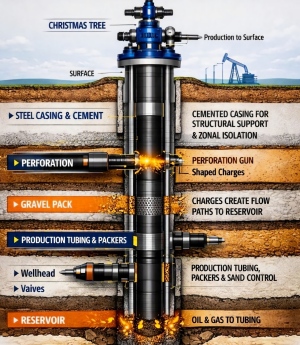
The process begins with the installation of steel casing, which is cemented in place to stabilize the wellbore and prevent collapse. This casing also acts as a protective barrier, safeguarding groundwater from contamination and isolating different geological formations. Depending on the design, several of types of casing may be used, including surface casing, intermediate casing, production casing, conductor casing, liners, and liner tiebacks.
2, Hole completions
Once the casing is secured, openings must be created to allow hydrocarbons to flow into the wellbore. This is achieved using perforating guns. Wells may be completed as open hole(without casing across the reservoir) or cased hole(with casing and cement across the reservoir interval).
3, Perforation cased hole completions, perforation is essential. Engineers lower a perforating gun and reservoir locating tools into the wellbore to create precise channels through the casing and cement. After perforation, a completion string-consisting of production tubing, packers, and other downhole equipment is installed to enable controlled production.
4, Gravel packing
In reservoir prone to sand production, gravel packing is employed as a filtration system. Gravel is placed around the screen or liner to prevent sand from entering the production stream, thereby protecting equipment and maintaining flow efficiency.
5, Production tubing placement
Production tubing is then run inside the casing to provide a conduit for hydrocarbons to reach the surface. Packers are set to seal the annulus between tubing and casing, preventing fluid migration. Additional equipment such as valves, gauges, and chokes may be installed to regulate flow and control well pressure.
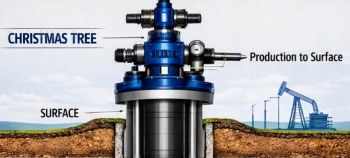
6, Christmas tree installation
The final step is the installation of the wellhead assembly, commonly referred to as the Christmas tree. This structure consists of valves, fittings, and control devices that manage production, monitor well pressure, and direct hydrocarbons to processing facilities or storage tanks. It serves as the critical interface between subsurface and surface operations.
7, Safety and maintenance
Safety is paramount throughout the well completion process. Proper design and execution prevent accidents, leaks, and environmental harm. Continuous monitoring and regular maintenance are essential to ensure the well remains safe, productive, and efficient throughout its operational life.