Three-way Valves
A three-way ball valve is a quarter-turn valve designed to direct, combine, or divert fluid flow between three ports. Unlike a standard two-way ball valve, it contains a specially machined ball with either an L-port or a T-port passage. An L-port ball connects two ports at a time, making it suitable for flow diversion or changeover duties. A T-port ball can connect all three ports simultaneously or provide multiple flow configurations, depending on the valve design. Three-way ball valves offer low pressure drop, tight shut-off, rapid operation, and high reliability because the spherical ball provides an effective seal against resilient valve seats. They are widely used in process industries, water treatment, chemical plants, and HVAC systems for mixing or diverting liquids and gases. Their compact construction, simple operation, and minimal maintenance requirements make them a preferred choice where frequent switching and dependable sealing performance are required.
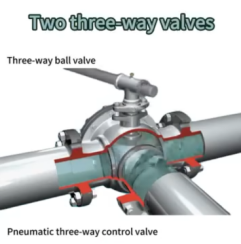
A pneumatic three-way control valve is an automatically actuated valve used to regulate, mix, or divert process fluids by means of a pneumatic actuator controlled by an instrument air signal. The valve body generally has three ports and is available in mixing and diverting configurations. In a mixing valve, two inlet streams are combined into a single outlet, whereas a diverting valve directs one inlet stream to either of two outlets. The actuator converts air pressure into linear motion, positioning the valve plug relative to the valve seats to achieve the desired flow rate. Pneumatic control valves are widely used because they provide fast response, fail-safe operation through spring return mechanisms, and are suitable for hazardous environments where electrical equipment may present ignition risks. Typical applications include temperature control, bypass control, heat exchangers, and process flow regulation in chemical, oil and gas, and power generation industries.