
IF VS REG?
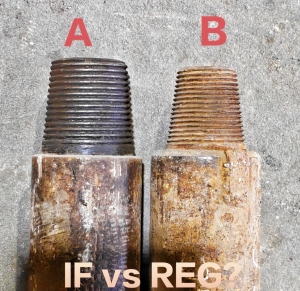
The answer is in the taper, TPI and thread profile.
IF(Internal Flush) has a coarser thread pitch with a more gradual taper.
Designed to maintain max bore size. REG(Regular) has a TPI thread with a steeper taper,built for strength and reliable makeup under heavy torque.
One important thing worth knowing. API introduced NC (Numbered Connection) to cover the full range of drill strings and officially declared IF and Full Hole(FH) connections obsolete. The reason was simple. Too many connections existed with slight variations across manufacturers causing confusion in the field. NC gradually replaced all IF connections in the API standard. With direct interchangeable equivalents like NC38 for 3-1/2” IF, NC46 for 4” IF and NC50 for 4-1/2” IF. So when someone on a modern rig calls it IF, they likely mean its NC equivalent.
Where they live in the drill string:
IF and its NC equivalents dominate drill pipe connections where flow efficiency matters. REG on the other hand meant for BHA components with less ID, and drill bits almost exclusively use REG threads, which is why bit subs exist to transition from the drill pipe NC connection down to the bit.
The tradeoff is straightforward. REG connection increases amount of pressure loss compared to IF due to ID restriction. But in a BHA you are not optimizing for hydraulics. You are optimizing for mechanical integrity. Moreover the length BHA is insignificant making overall pressure loss in BHA insignificant. The thread and steeper taper handle compression, high torque and the brutal vibration environment near the bit far better than a fine-threaded connection ever could.
That small sacrifice in pressure drop buys you a connection that makes up cleaner, holds tighter and survives the punishment of rotary drilling.