Centralizers: The Small Component that Makes a Big Difference
When discussing well construction, attention often goes to casing, cement, drilling fluids, and completion equipment. Yet one simple tool plays a critical role in achieving a successful cement job and maintaining long-term well integrity: the casing centralizer.
A centralizer is installed on the outside of the casing string to keep it centered within the wellbore. This creates a more uniform annular space, allowing cement to flow evenly around the casing and form an effective seal.
Why is this important?
-Improves cement placement and coverage
-Enhances zonal isolation between formations
-Reduces the risk of gas migration and channeling
-Supports long-term well integrity and casing protection
-Minimizes costly remedial cementing operations
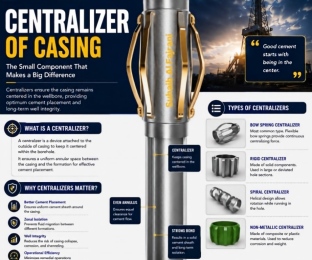
Common types of Centralizers:
-Bow Spring Centralizers: Flexible and widely used in vertical and deviated wells.
-Rigid Centralizers: Suitable for challenging hole conditions and high side loads.
-Spiral Centralizers: Help improve mud displacement and cement distribution.
-Non-Metallic Centralizers: Lightweight and corrosion-resistance alternatives.
Key Factors for Effective Centralization:
-Proper placement along the casing string
-Correct quantity based on well design
-Consideration of hole geometry and deviation
-Appropriate centralizer size and material selection
Although centralizers may seem like a small component, their impact on cement quality, zonal isolation, and overall well performance is significant. In many cases, a successful cement job starts with ensuring the casing is positioned exactly where it should be at the center of the wellbore.