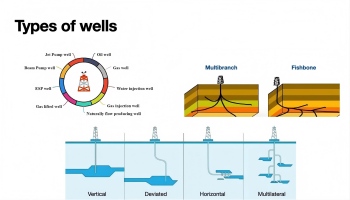
Types of Wells
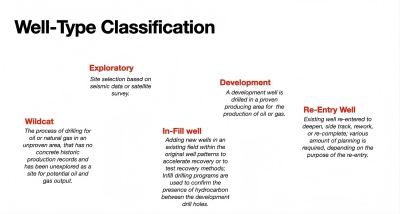
1, Reference well: A well drilled during the regional reconnaissance stage to understand stratigraphic depositional characteristics and hydrocarbon potential, to verify geophysical exploration results, and to provide geophysical parameters.
-Understand the strata,such as lithology, sedimentary environment, thickness, stratification.
-Verify the geophysical exploration interpretation, the results inferred by seismic, gravity magnetic and electric methods.
-Determine whether it contains oil & gas, location and nature of oil & gas reservoirs.
-Provide geophysical parameters, logging data such as acoustic waves, density and resistivity.
2, Stratigraphic profile well: A well drilled across a large regional area in a covered zone to establish stratigraphic profiles and understand regional geological characteristics.
3, Parametric well: A well drilled within a hydrocarbon-bearing basin to investigate regional geological structures and to obtain rock petrophysical parameters.
4, Structural well: A well drilled to map the structure of a specific subsurface maker bed, to understand its geological structural characteristics, and to verify geophysical exploration results.
5, Exploration well: A well drilled within favorable hydrocarbon-bearing structures or oil & gas field areas to determine the presence of hydrocarbon reservoirs, delineate reservoir boundaries, conduct industrial evaluation, and obtain geological data required for development. Exploration wells can be further classified into wildcat wells, preliminary exploration wells, and detailed exploration wells.
6, Data well: A well drilled to obtain data for preparing an oil & gas field development plan, or to acquire data for specific studies during the development process.
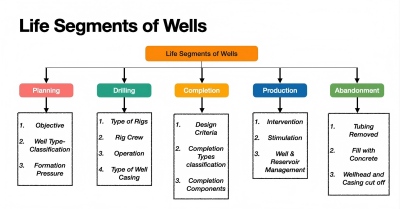
7, Production well: A well drilled during oil & gas field development for the production of petroleum and natural gas. Production wells can be classified into oil production wells and gas production wells.
8, Injection well: A well drilled to inject water or gas into an oil field in order to enhance revovery and accelerate development by supplementing and effectively utilizing formation energy.
9, Observation well: A well drilled during the water-cut stage of oilfield development to determine the pressure of various reservoirs, the distribution of oil, gas and water, the distribution and variation of remaining oil saturation, and to evaluate the effectiveness of adjustment and enhanced recovery measures.
10, Monitoring well: A well drilled during oil & gas field development to monitor subsurface dynamics of the reservoir, including reservoir pressure, water-cut variation, and interlayer fluid flow behavior.
11, Adjustment well: A well drilled in the later stage of oil & gas field development to adjust the existing well pattern, improve development performance, and enhance the ultimate recovery factor. Wdjustment wells may include production wells, injection wells, and observation wells.