Types of Choke
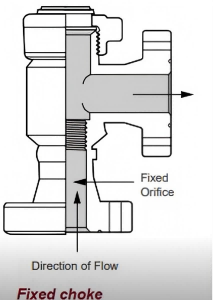
Positive of Fixed Choke
This normally consists of two parts:
1, A choke which consists of a machined housing into which the orifice capability or “bean” is installed.
2, A “bean” which consists of a short length 1-6”, of thick-walled tube with a smooth, machined bore of specified size.
Fixed chokes are occasionally installed in wireline nipples at depth in the tubing string in certain wells to:
-Reduce the tubing head pressure and operating pressures on the Xmas tree and wellhead.
-Counteract the effects of hydrates and wax deposition associated with fluid expansion and cooling. The location of cooling is moved down into the tubing string where the fluid can extract heat from the surrounding formation as it flows to surface.
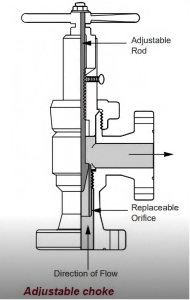
Valves seat with adjustable valve stem
In this design, the choke is normally located on a 90°bend. The orifice consists of a valve seat into which a valve stem can be inserted and retracted, thus adjusting the orifice size.
The movement of the valve stem can either be manual or automatic using an hydraulic or electrohydraulic controller.
Positive chokes are particularly useful where the fixed orifice is essential for monitoring well performance, eg, during well tests. The pressure drop across the choke depends upon the fluid characteristics, the flowrate and choke dimensions.
An adjustable choke allows the back pressure on the well to be varied. This may be useful in the following instances:
1, When initiating production on a well, in which the tubing contents have to be displaced out of the well by inflow from the reservoir. In this case, the FBHP will decline and hence the production rate increases continuously during this period, thus necessitating the application of gradually increasing back pressure.
2, To control a well on cylical production, or where frequent changes in production rate are necessary.
3, On wells which are frequently subject to shutdown.
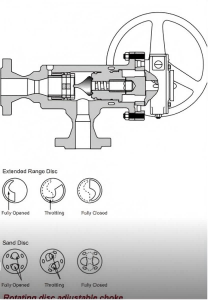
Rotating Disc Choke
This type of adjustable choke. It consists of a 90°flanged bend which can be coupled up to the flowline or Xmas tree. Internally, there are two discs made from tungsten carbide, ceramic or other erosion-resistant material. Both discs have two ports which are diametrically opposite in each disc.
The rear disc is fixed whilst the front disc located on top of it can be rotated through a maximum of 90°via a fork, externally controlled manually or remotely. The ports can be of a circular or of a range of alternative shapes.